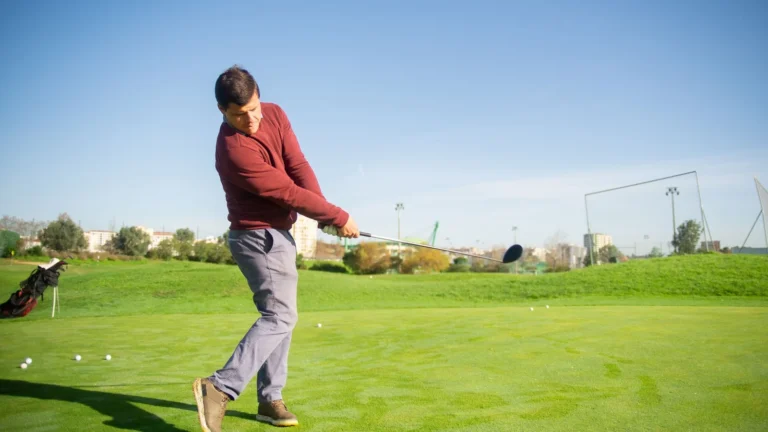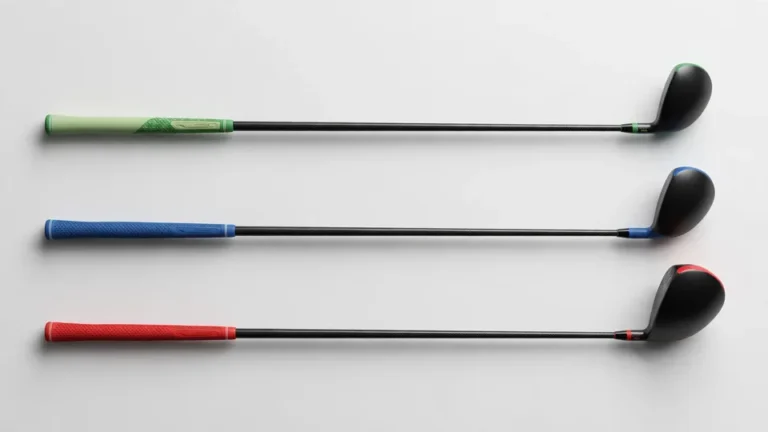
Here is a training aid that looks like a lime-green stress ball with sticks poking out of it, and somehow Rory McIlroy was spotted using one on a DP World Tour range. That is the Connector by Sure Golf in a nutshell: strange to look at, surprisingly simple to use, and built around one of the oldest fundamentals in the golf swing, keeping your arms connected to your body. You squeeze this soft foam wedge between your forearms and swing; if your arms separate, chicken wing, or the right elbow flies, it falls to the ground. Instant feedback, no launch monitor required. But does a $75 foam ball actually change your swing, or is it another gadget destined for the garage? I dug through every serious review, from MyGolfSpy to bunkered’s range session with the inventor himself, to find out.
Quick Verdict
Price: $74.99 ($99.99) on sure-golf.com · Rating: ★★★★★ 4.5/5
Best for: Golfers fighting a chicken wing, flying right elbow, or arms that separate from the body, and who will actually practice 10 minutes a few times a week.
Bottom line: The Connector does exactly what it promises: it makes arm-body disconnection physically impossible to ignore. Reviewers consistently praise the instant feel and the versatility, it works from putter to driver. It is not perfect, it can slip out on bigger swings and lasting change takes weeks, but as a connection trainer it is one of the best-reviewed options in golf.
What Is the Sure Golf Connector?
The Connector is a golf training aid made by Sure-Golf, a UK company founded by PGA Professional and Tour coach Dan Frost. Frost has coached European Tour players and elite juniors, including Open champion Georgia Hall, so this is not a gadget dreamed up in a marketing meeting. The product has been on the market since around 2023 and is now in its second generation, refined with feedback from Tour players.
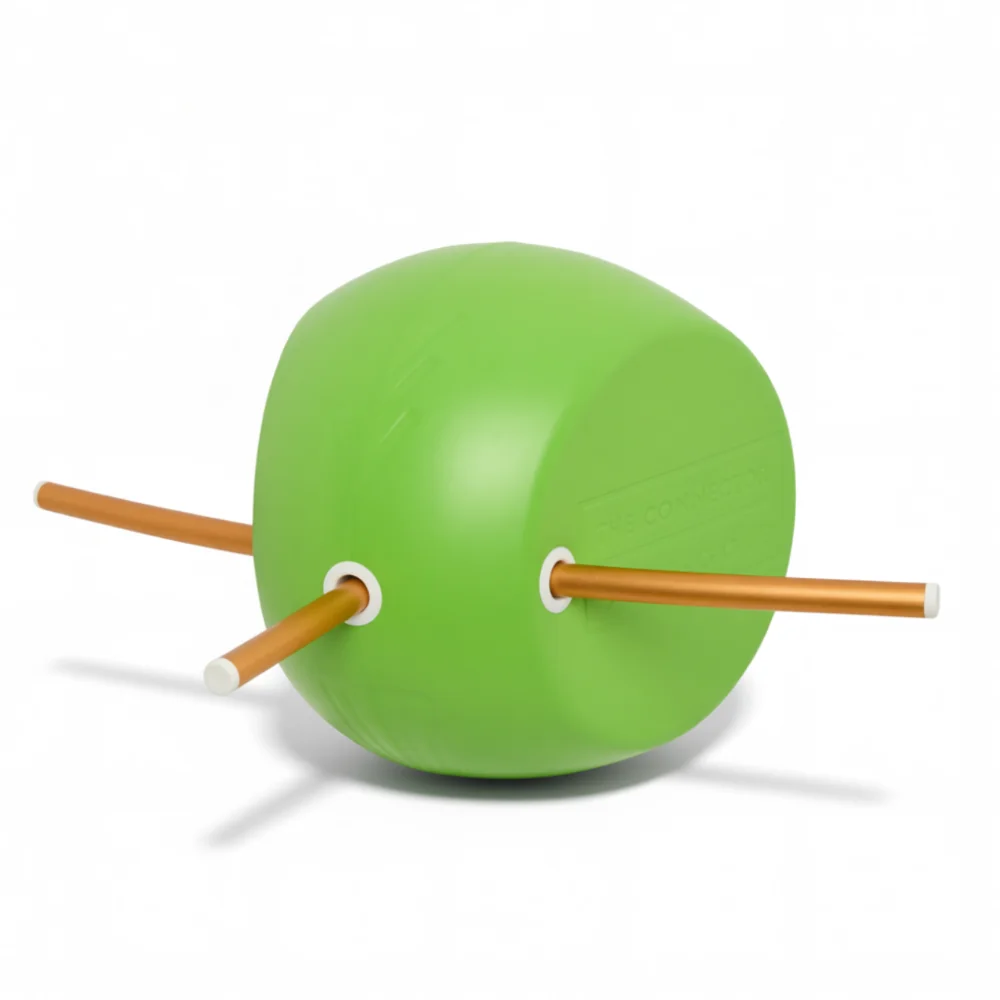
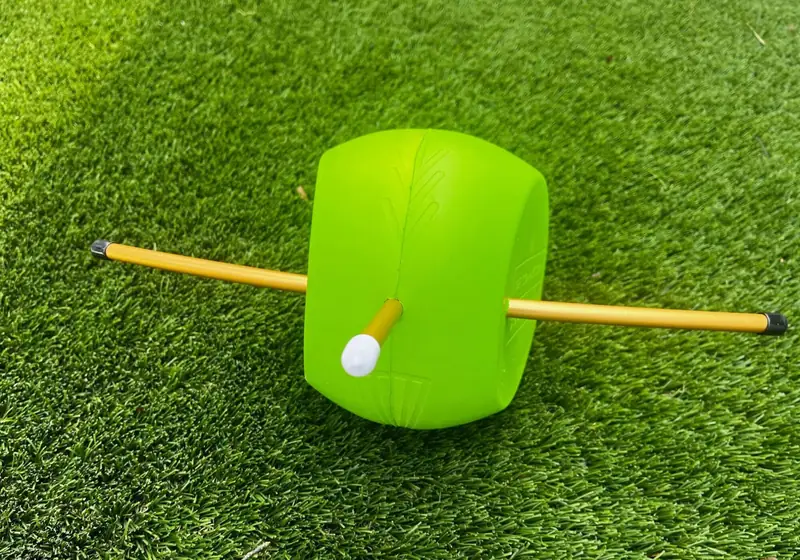
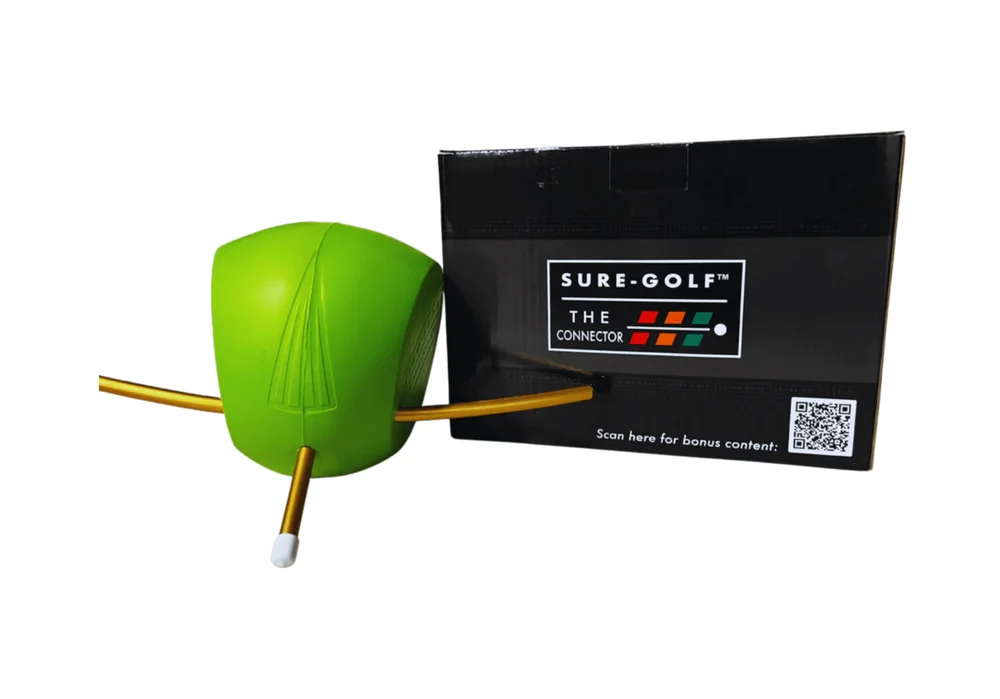
Physically, it is a soft memory-foam ball, wedge-shaped rather than round, with contoured sides that sit between your forearms. Three alignment rods stick out of it: a centre rod with a white tip, and two curved rods across the top. It comes in a standard adult size and a smaller junior version, and it works for both right- and left-handed golfers. The design is patented, according to the company, and Sure-Golf says it has been validated with Gears 3D biomechanics testing.
How the Connector Actually Works
The mechanism is pure simplicity, which is why coaches like it. You place the foam wedge between your forearms with the alignment rods pointing up, squeeze just enough to hold it in place, and swing. As long as your arms and body rotate together as one unit, the Connector stays put. The moment your structure breaks down, arms separating from the torso, the right elbow flying out, the classic chicken wing through impact, it drops. You cannot argue with gravity.
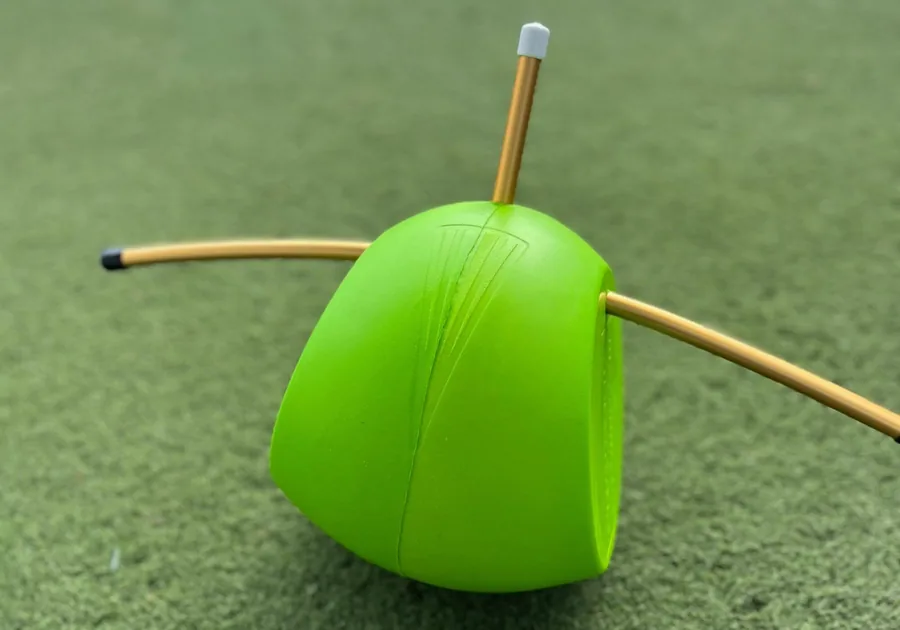
The three rods are not decoration. The centre rod gives you a visual reference for forearm rotation and shaft lean at impact, while the curved rods show whether your arms stay level at address and through the swing. So you get two kinds of feedback at once: the physical kind (it falls) and the visual kind (the rods tell you what your arms did).
This is what separates the Connector from a plain foam ball or a rolled-up towel between the arms, the old-school drill it replaces. A towel gives you the drop feedback but nothing else. The rods add the alignment layer, which is why bunkered’s tester, working with Dan Frost himself on a Tour range, called it a “huge help” for arm-chest disconnection and said it made chicken-winging “basically impossible.”
How to Use the Connector Golf Training Aid
Sure-Golf teaches it as three steps, and reviewers generally agree with the progression below. If you searched “how to use the connector golf training aid,” this is the section for you.
Step 1: Set your structure. Slide the Connector between your forearms with the alignment rods pointing up. The centre rod should point roughly at the ball. Check in a mirror that your arms look level, the curved rods make this easy to see.
Step 2: Swing with connection. Take the club back with your arms and body moving as one piece. Do not squeeze hard, just enough pressure to keep it in place. If the ball drops, your arms separated. That is the lesson.
Step 3: Rotate through impact. Keep the connection as you turn through the ball. At impact, glance at the centre rod: it shows your shaft lean and forearm rotation. If the rods stayed intact through the whole motion, your structure held.
Reviewer tips worth stealing: start with chipping and pitching before full swings (MyGolfSpy). Slow your backswing down slightly at first, you will not lose power (MyGolfSpy). Try five swings with the Connector followed by five without, so you learn the feel and then own it yourself (MyGolfSpy). And yes, it works for putting too, which makes it genuinely versatile rather than a one-trick aid.
What Comes in the Box?
Not much, and that is both a pro and a con. You get the Connector itself, fully assembled and ready to use. There are no printed instructions in the box, which Independent Golf Reviews flagged as an annoyance. Everything is taught through Sure-Golf’s website and app instead.
The consolation prize is a good one: buying the Connector includes access to the Sure-Golf Knowledge Centre, more than 100 structured video lessons from Dan Frost covering the full swing. For a training aid that lives or dies on correct use, that library matters more than a paper manual.
Sure-Golf also sells bundles if you want the full system: the Core Kit at $82.99 and the Tour Kit at $94.99, which adds the Radius Strap ($9.99 on its own) and a Tour backpack.
The Connector vs the Alternatives
The Connector is not the only way to train arm connection. Here is how it stacks up against the main alternatives, from direct competitors to budget workarounds. For the wider field, see our best golf swing trainers roundup.
| Training Aid | Type | Price | Standout Feature |
|---|---|---|---|
| The Connector (Sure Golf) | Foam wedge + 3 alignment rods | $74.99 ($99.99) | Rods add visual feedback; Tour validated |
| The Compression Ball | Memory-foam ball + anti-drop lanyard | $54.99 | Lanyard fixes the slip problem; cheaper |
| Elastic arm bands | Strap around arms | ~$28-$34 | Cheapest; can feel restrictive |
| Tnzudu (Amazon knockoff) | Hard-foam Connector copy | $27.99 | Cheap, but hard foam gets abandoned (MGS) |
| TRS Slider | Chest-and-arm strap | Varies | Targets over-the-top/slice pattern |
The most interesting rival is the Compression Ball at $54.99. It is essentially the same concept, a foam ball between the forearms, but it adds an anti-drop lanyard, which directly answers the Connector’s most common complaint. If the idea of the ball falling out mid-swing bothers you, that lanyard is worth the tradeoff of losing the alignment rods.
The Amazon knockoffs deserve a warning. MyGolfSpy tested the $28 Tnzudu copy that looks nearly identical and found the hard foam uncomfortable enough that golfers simply stop using it. The Connector’s ultra-soft memory foam is not marketing fluff, it is the difference between an aid you use for thousands of reps and one that gathers dust.
What Independent Reviewers Say
The review consensus on the Connector is unusually consistent. MyGolfSpy’s tester, a scratch golfer, called it “worth the price,” praised the instant feel, and liked that it works at home without a range, though she pushed back on the “most versatile training aid in golf” slogan. Independent Golf Reviews gives it a yes, with the caveat that lasting change takes weeks to months of regular practice, and suggests the Lag Shot instead if what you really want is ball-flight feedback.
Bunkered’s range session is the most convincing evidence. Testing with Dan Frost on a DP World Tour range, the reviewer found it a “huge help” for arm-chest disconnection and credited it with improving wrist angles and strike quality. GOLF.com’s coverage focuses on Rory McIlroy’s use, specifically for wrist position in the backswing and delivery positions. Fairway Jockey buyers rate it 4.5/5, with the recurring complaint that it “tends to slip and fall off, especially during bigger swings” and “could really use a strap or Velcro.”
For balance: Amazon buyers give it around 4.0/5, with most complaints about bulk for smaller-framed golfers (the junior version is the fix) and one report of a rubber end cap coming loose. Nobody disputes that the core concept works.
External sources: Sure-Golf official product page, MyGolfSpy review, Independent Golf Reviews, bunkered range test, GOLF.com on Rory McIlroy’s use.
Pros and Cons
Pros
- Instant physical feedback, feel connection from the very first swing
- Genuinely versatile: putting, chipping, pitching, full swing, driver to putter
- Alignment rods add a visual layer a plain foam ball cannot match
- Soft memory foam stays comfortable for thousands of reps
- Tour validation: Rory McIlroy and Edoardo Molinari use it
- 100+ free video lessons included via the Knowledge Centre
- Ambidextrous, with a junior size available
Cons
- Can slip and fall out on bigger, faster swings, no strap included
- No printed instructions in the box, website/app only
- Real swing change takes weeks to months, not a quick fix
- $75 to $100+ depending on retailer, not the cheapest option
- Can feel bulky for smaller-framed golfers near the sternum
- Cheap hard-foam knockoffs confuse buyers on Amazon
FAQs
How do you use the Connector golf training aid?
Slide the foam wedge between your forearms with the alignment rods pointing up and the centre rod aimed at the ball. Squeeze lightly, take the club back with arms and body moving together, and rotate through impact. If your arm structure breaks down, the Connector drops, which is the feedback. Start with chips and pitches before progressing to full swings.
Does the Connector fall out during swings?
It can, especially on bigger or faster swings, and this is the most common user complaint. The fix is to start with slower, shorter swings and only add speed once the feel is grooved. If it bothers you, the Compression Ball ($54.99) is a similar aid with an anti-drop lanyard.
Is the Connector worth $99?
At the official $74.99 sale price, reviewers consistently say yes for golfers who struggle with arm-body connection and will practice regularly. At full retail ($99-$110 at some shops), it is still fairly priced against the category, but shop around, the official site is usually cheapest.
What is the difference between the Connector and cheap Amazon knockoffs?
The knockoffs (around $28) copy the shape but use hard foam instead of the Connector’s ultra-soft memory foam. MyGolfSpy tested one and found it uncomfortable enough that golfers abandon it. Comfort is the whole point of a reps-based aid, so the foam quality matters more than it looks.
Does the Connector work for left-handed golfers?
Yes. The design is ambidextrous, the wedge sits between the forearms the same way regardless of handedness. There is also a smaller junior version for young golfers.
How long before the Connector changes my swing?
Expect weeks to months of regular practice, not days. Independent Golf Reviews is blunt about this: the feel is instant, but owning the new movement takes repetition. Five to ten minutes, a few times a week, is the realistic prescription.
How We Research
We do not pretend to have tested every product hands-on. Instead, we read everything: the official product pages, independent reviews from MyGolfSpy, Independent Golf Reviews, bunkered, and GOLF.com, plus verified buyer feedback from Amazon and specialty retailers. We cross-check claims against each other, flag contradictions, and only recommend products where the reviewer consensus is genuinely strong. Prices were checked in October 2026 and change frequently.
Final Verdict
★★★★★ 4.5/5. The Connector by Sure Golf is one of the best-reviewed connection trainers in golf, and the consensus is unusually unified: the feel is instant, the concept is sound, and the alignment rods genuinely add something a plain foam ball cannot. Deduct half a point for the slip issue on full swings and the lack of printed instructions.
If your miss is a chicken wing, a flying right elbow, or arms that disconnect from the body, this is the aid built exactly for that fault. Buy it from the official Sure-Golf site at the $74.99 sale price, start with chipping, and give it a month. Once the connection feel is grooved, our shallow-the-club drills are a natural next step for the downswing. Just do not expect a miracle in a week, no training aid works that way.