If your ball starts right and stays right, you’ve probably seen the ads. A little blue brick. A couple of alignment sticks. A guy promising it’ll fix your slice in one range session.
I’ll be straight with you: I haven’t bought one. This isn’t a “here’s what happened when I tested it for 30 days” review, because I don’t fake those. What I did instead was dig through the manufacturer’s specs, read the independent reviews that actually exist, and go through dozens of buyer comments to figure out whether the Blue Brick is legit or just good marketing.
Here’s everything I found, the good and the bad.
Key Takeaways:
- The B29 Blue Brick (~$129) is an 11-in-1 swing path trainer that gives instant physical feedback via alignment sticks.
- Best for slicers and over-the-top swings; useless for putting.
- 60-day money-back guarantee makes it low-risk to try.
- Sold direct-only — no Amazon option.
- Our rating: 8/10.
What Is the Blue Brick?
The Blue Brick — officially the B29 Blue Brick — is a golf swing training aid made by Top Speed Golf (also sold under their Shotcraft Golf brand). That’s Clay Ballard’s company. If you watch golf instruction on YouTube, you’ve seen him — he’s a Golf Digest-recognized instructor with a huge following, and this is his flagship training aid.
Physically, it’s simple. It’s a dense, heavy-duty block — roughly the size of a dozen golf balls, according to the manufacturer — with 11 slots cut into it. You slide alignment sticks (included in the box) into the slots, and the sticks become physical guides for your swing.
The idea is something called “constraints-led learning” — fancy term, simple concept. Instead of juggling ten swing thoughts, you set up a physical barrier and your body figures out the right move on its own. Put the stick in the slot, make your swing, and try not to hit the stick. Hit it? Your path was wrong. Miss it? You did it right. Instant feedback, no launch monitor required.
The 11 slots break down like this:
- 3 shallowing slots — set at the average downswing angles tour pros use for the driver, 6-iron, and sand wedge
- 1 inside swing path guide — for learning to swing from the inside and hit draws
- 1 wedge impact slot — trains forward shaft lean for better compression
- 1 wedge launch angle guide — set at 30 degrees, the launch angle pros target with wedges
- 2 square divot / angle of attack slots — for cleaner, more consistent contact
- 3 alignment and ball position guides — the boring-but-essential setup stuff
There’s also a QR code printed on the brick itself that links to setup videos and drills, which is a nice touch. Nobody wants to stare at a block of plastic wondering what to do with it.
How It Works (In Plain English)
You pick the slot for whatever you’re working on. Say you’re fighting an over-the-top move with your 6-iron — you’d use one of the shallowing slots. Stick goes in, you address the ball with the brick sitting just outside your swing path, and you swing.
The rule is dead simple: don’t hit the stick.
If you come over the top like most amateurs do, you’ll smack the stick on the way down. You’ll know instantly, and you’ll feel exactly what “too steep” feels like. When you finally shallow the club correctly, you miss the stick completely. That contrast — wrong versus right, felt in your hands in real time — is the entire product. It’s the difference between a coach saying “shallow it” for the hundredth time and your body actually learning what shallow feels like.
The wedge slots handle shaft lean and launch angle, the alignment slots handle setup, the divot slots work on low-point control. One tool, a bunch of jobs — though realistically, most golfers will camp out on two or three slots and ignore the rest.
Who It’s For (And Who Should Skip It)
This thing makes the most sense for you if:
- You slice the ball or come over the top. This is the core audience, full stop. Almost every positive buyer comment mentions fixing a slice or steep swing.
- You’re a feel-based learner. If video analysis makes your eyes glaze over but physical feedback clicks for you, the stick-don’t-hit-it concept will make sense immediately.
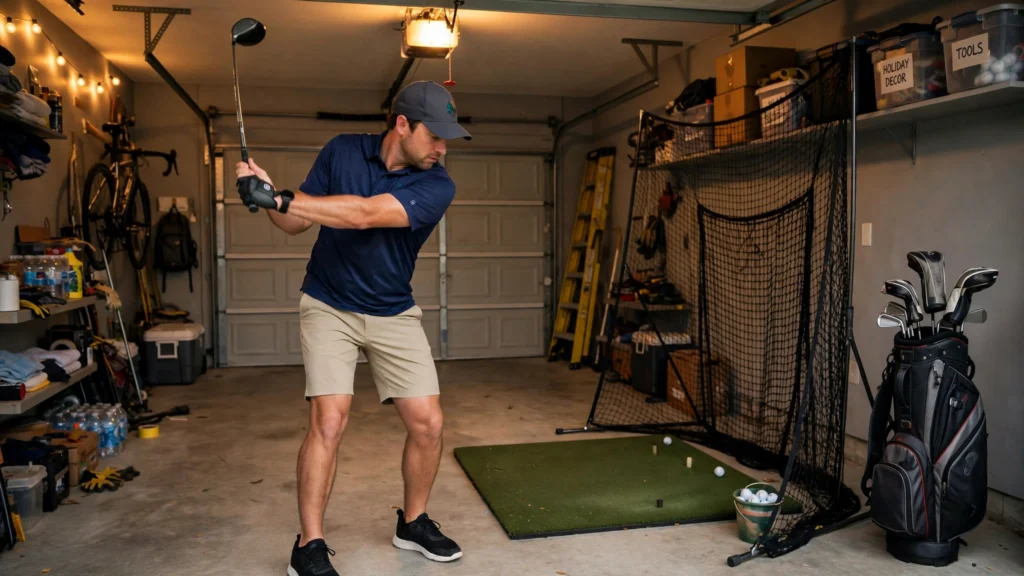
- You practice indoors or in a garage. Because it sits low to the ground, it works fine on a mat or in a simulator setup. No turf required.
- You’ve bought training aids before and abandoned them. Multiple buyers specifically said this is the first aid they actually kept using, mostly because it does more than one thing.
Skip it if:
- Your main problem is putting or chipping. The Blue Brick is a full-swing tool. It does nothing for your stroke on the greens.
- You won’t do the reps. No training aid fixes a swing by sitting in your garage. The brick gives great feedback, but you still have to swing it a few hundred times.
- You’re on a tight budget. At $129 to $169, this isn’t an impulse buy, and there are solid training aids under $50.
- You travel a lot with your clubs. It’s heavier and chunkier than it looks in the ads — more on that below.
Blue Brick Pros and Cons
Let’s put it all on the table.
Pros:
- The feedback is instant and unmistakable. You either hit the stick or you don’t. There’s no interpreting data or wondering if you did it right.
- It’s genuinely versatile. Eleven functions in one tool that fits in your golf bag beats owning five single-purpose gadgets collecting dust.
- It works indoors. Garage, basement, simulator room — anywhere you can swing a club, the brick works. That’s a big deal for winter practice.
- The 60-day money-back guarantee is real — two months to decide, which takes most of the risk out of the price.
- The instruction support is solid. The QR-code videos mean you’re not guessing at setups, which is where most training aids fail.
Cons:
- It’s expensive. $169 at full price is steep. It usually sells for $129, which is better, but that’s still more than a lot of excellent training aids. One independent reviewer put it bluntly: it’s priced higher than some of the best-known swing trainers on the market.
- It’s heavy and not very portable. This surprised me. For something marketed as bag-friendly, multiple reviewers note it’s chunkier than expected. It’s a “keep it in the trunk” tool, not a “toss it in your carry bag and fly to Florida” tool.
- No short game application. Putting, chipping, bunker play — the brick doesn’t touch any of it. If you want one tool for your whole game, this isn’t it.
- Expect upsells. The checkout flow pushes hard toward video courses and memberships. The brick works fine without them, but the sales funnel is aggressive.
- Direct-only sales. You can’t grab it on Amazon to compare prices or read verified-purchase reviews. It’s the official site or nothing.
How It Compares to Alternatives
The Blue Brick doesn’t exist in a vacuum, so here’s how it stacks up against two of the most popular alternatives. Full disclosure: we may earn a commission if you buy the Divot Board or Orange Whip through links on our site — at no extra cost to you. The Blue Brick itself is only sold direct, so there’s no affiliate angle there. Our take doesn’t change either way.
Divot Board: This one solves a different problem. Where the Blue Brick guides your swing path, the Divot Board shows you where the club hit the ground — instant visual feedback on your strike location and angle of attack. Think of it this way: the brick teaches your body the right move, the Divot Board shows you the result. They’re honestly complementary, not competitors. If your contact is thin and fat more than it’s offline left or right, start with the Divot Board. If your ball flight is the problem (slices, pulls), start with the brick.
Orange Whip: Another different animal entirely. The Orange Whip is a weighted, flexible trainer built for tempo and rhythm — it teaches you to swing smooth instead of yanking at the ball from the top. It won’t fix your swing path the way the brick does, and the brick won’t fix a jerky tempo the way the Whip does. Plenty of golfers own both: Whip for the warmup, brick for the path work. If I had to pick one for a chronic slicer, I’d take the brick. For someone whose swing feels rushed and out of sync, the Whip.
The honest summary? These three tools barely overlap. The marketing wants you to think there’s one winner, but your swing flaw should pick the tool, not the other way around.
Price and Value: Is It Worth $129?
Here’s the pricing as of this writing: list price is $169, but it routinely sells for $129 on the official site, with free US shipping and a 60-day money-back guarantee. You’ll occasionally see discount codes floating around that knock it down closer to $115–$125.
Is it worth it? Depends entirely on your answer to one question: is your swing path your biggest problem?
If yes — if you’re steep, over the top, slicing, and you’ve tried fixing it by feel with no luck — then $129 for a tool with a 60-day guarantee is reasonable. The manufacturer’s claim is that buying separate aids for everything the brick does would run you $300 to $500. That’s marketing math, but the underlying point holds: it’s cheaper than three or four single-purpose trainers.
If your path is fine and your issues are elsewhere (short game, tempo, strike location), the value drops fast. A $129 path tool won’t help a putting problem.
The guarantee changes the math, though. Two months is enough to know whether the feedback clicks for you — not many training aids offer that.
Blue Brick FAQs
Does the Blue Brick work for beginners?
According to the manufacturer, yes — it’s designed for beginners, intermediates, and experienced golfers. Realistically, a total beginner might find the 11 slots overwhelming at first. The QR-code videos help, but if you’ve never worked on swing mechanics before, start with just the alignment slots and add the path work later.
How long before you see results?
The feedback is immediate — you’ll know on swing one whether your path is off. But “feedback” and “a better swing” aren’t the same thing. Buyer comments range from “fixed my slice in one range session” to more measured takes about grooving the move over a few weeks. Be skeptical of overnight-transformation stories — those on-site reviews are curated by the seller. Plan on a few weeks of regular reps for anything lasting.
Is there really a money-back guarantee?
Yes. 60 days, full refund if you’re not happy. That’s one of the stronger guarantees in the training aid world, and it’s the main reason the price is easier to swallow.
Where can you buy the Blue Brick?
Only through the official Top Speed Golf / Shotcraft Golf website. It’s not on Amazon or in golf retail stores as far as I can tell. That keeps the pricing consistent, but it also means you can’t comparison-shop or lean on Amazon’s review system.
How We Research:
We don’t fake hands-on testing. Every review is built from the manufacturer’s published specs, independent expert reviews, and patterns across dozens of buyer comments. If we can’t verify a claim, we say so.
Final Verdict
So, is the Blue Brick worth buying? Here’s my honest take after all this research:
It’s a well-designed tool that does exactly what it claims to do. The concept is sound — physical constraints beat swing thoughts for most amateurs — and the buyer feedback, even accounting for the fact that on-site reviews are cherry-picked, is unusually enthusiastic. The independent review I found landed in the same place: it works, it’s just pricey.
I’d buy it if I were steep and over the top and serious about fixing it. I’d skip it if my problems live inside 100 yards, or if I’m not going to put in the reps, because no $129 block of plastic fixes a swing by itself.
Rating: 8/10. Excellent at its specific job, docked for the price and the lack of portability.
If you do grab one, use the guarantee. Two months, real practice, and you’ll know. That’s about as risk-free as golf purchases get.
About The Swing Guide
We’re golf obsessives who research training aids so you don’t waste money on duds. Every guide combines specs, independent reviews, and real buyer feedback. No sponsored picks, ever.
Pingback: How to Shallow the Golf Club: 5 Drills That Actually Work (2026)