
Let’s get one thing straight before we go any further: a golf swing trainer won’t fix your swing by itself. No training aid on earth can do that.
What the good ones do — and I mean the genuinely good ones — is give you feedback you can’t argue with. Your buddy on the range might tell you you’re coming over the top. A swing trainer makes you feel it. That’s the difference, and it’s why tour pros have been swinging weighted clubs and alignment contraptions since long before YouTube instructors existed.
But here’s the catch nobody mentions in those glossy ads: buying the wrong trainer for your problem is worse than buying nothing at all. A tempo trainer won’t fix a slice. A speed stick won’t fix your chunked irons. Match the tool to the flaw, or you’re just donating money to the golf industry.
So that’s what this guide is. Seven swing trainers, each matched to the specific swing flaw it actually fixes. I dug through the specs, the independent reviews, and hundreds of buyer comments to sort the legit from the gimmicky. No filler, no fluff — just what each one does, who it’s for, and the honest downsides the manufacturers won’t put on the box.
Key Takeaways:
- Match the trainer to your swing flaw — tempo, path, speed, strike, or fitness.
- Best overall: Orange Whip (tempo); best value: SKLZ Gold Flex (~$80).
- Prices range ~$80–$200; one well-chosen trainer beats three random ones.
| Trainer | Best For | Approx. Price | Our Rating |
|---|---|---|---|
| Blue Brick B29 | Over-the-top swing / slice | ~$129 | 8/10 |
| Orange Whip | Tempo & rhythm | ~$110–120 | 9/10 |
| Divot Board | Chunked & thin irons | ~$100 | 8/10 |
| SKLZ Gold Flex | Budget tempo training | ~$80 | 8/10 |
| SuperSpeed Golf | Swing speed | ~$200 | 8/10 |
| GolfForever Swing Trainer | Golf fitness & mobility | ~$200 | 7/10 |
| Lag Shot 7-Iron | Lag & tempo feel | ~$99–119 | 8/10 |
1. Blue Brick B29 — Best for an Over-the-Top Swing Path
If your miss is a slice, a pull, or that weak flare to the right that shows up whenever there’s trouble, your swing path is almost certainly the culprit. The Blue Brick B29 from Top Speed Golf exists for exactly this golfer.
It’s a heavy blue block — yes, it really does look like a brick — with 11 slots for alignment sticks. You set the sticks at specific angles, and the whole idea is built around “constraints-led learning”: if your downswing is too steep, you smack the stick. If you shallow the club correctly, you miss it. Instant, brutal, undeniable feedback. No interpretation needed.
The Brick also covers alignment, ball position, and wedge launch angles through its other slots, so it’s more versatile than it looks at first glance. Price hovers around $129 (it’s frequently discounted from $149), and it’s sold direct-only through the manufacturer’s own site — you won’t find it on Amazon. They back it with a 60-day money-back guarantee, which takes some of the sting out of the direct-only buying experience.
Best for: Slicers and anyone fighting an over-the-top move.
Pros:
- Feedback is immediate and impossible to misread
- Covers path, alignment, and wedge setup in one tool
- 60-day money-back guarantee
Cons:
- Sold direct-only, so no Amazon convenience or fast shipping
- Looks strange and takes a few sessions to understand the setups
- At ~$129, it’s not cheap for what is essentially a very clever brick
2. Orange Whip — Best All-Around Tempo Trainer
Ask a dozen teaching pros to name one training aid, and the Orange Whip comes up more than anything else. There’s a reason the company says it’s been voted a top teaching and training aid by PGA and LPGA professionals.
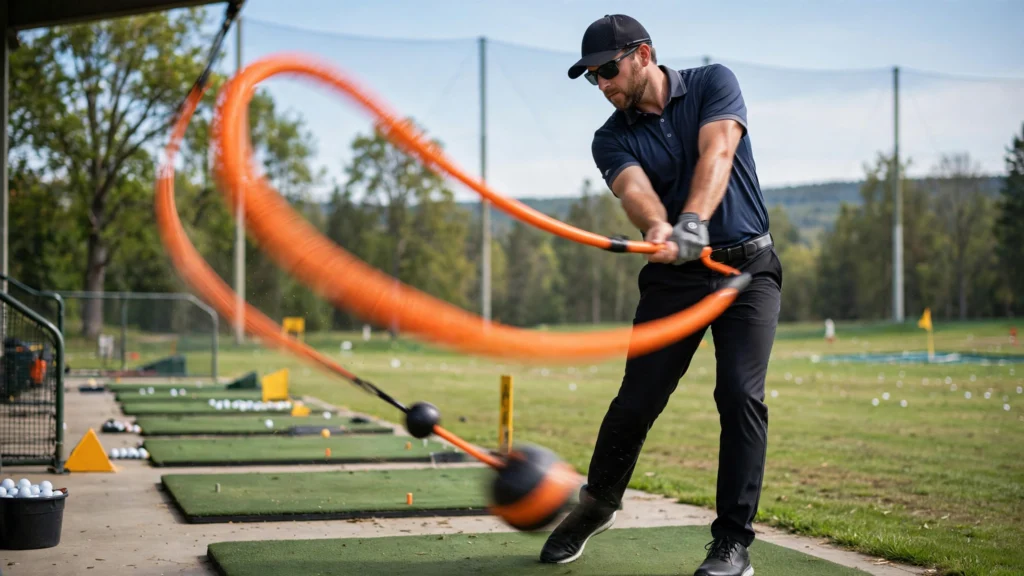
It’s a long, flexible, counterbalanced shaft with a weighted ball on one end. Swing it, and the whip action punishes anything jerky or off-plane — you feel heavy and awkward when your sequence is wrong, light and rhythmic when it’s right. It trains tempo, balance, and swing plane all at once, which is why it works as both a practice tool and a pre-round warmup. Tour players use these things daily; you’ll spot them on ranges everywhere.
It comes in four sizes. The standard 47-inch model (around $110–120) suits most men; the 43-inch mid-size is the pick for seniors, women, and teens. The price has crept up over the years, but it’s widely available at major retailers, which is more than you can say for some direct-only competitors.
Best for: Golfers with a quick transition, jerky tempo, or balance issues. Honestly? Almost everyone.
Pros:
- The most proven tempo trainer in golf, with genuine tour usage
- Doubles as an excellent warmup tool
- Multiple sizes for different body types
Cons:
- Won’t fix a path problem on its own — it’s a tempo tool, not a path tool
- The price keeps creeping upward
- Takes up real space; not ideal for tiny apartments
3. Divot Board — Best for Chunked and Thin Iron Shots
Chunk one, thin the next, pure one out of nowhere — if that sounds like your iron play, your low point control is the problem. The Divot Board is the simplest fix I’ve seen for it.

It’s a 6-by-21-inch board with a special surface that records exactly where your club strikes the ground. Fat? Thin? Toe? Heel? You see it instantly, on every swing, with or without a ball. That makes it one of the best indoor practice tools in golf, because you finally get turf-interaction feedback without needing actual turf. Around $100 (often on sale from $140), and the pads are replaceable when they wear out, which independent reviewers consistently praise as a sign of a company that built the thing to last.
The feedback is almost embarrassingly honest. That’s the point. You can’t tell yourself you “caught it pretty clean” when the board shows your divot started three inches behind where the ball was.
Best for: Anyone who chunks or thins irons, and winter/indoor practicers.
Pros:
- Instant, visual proof of strike quality on every swing
- Works indoors with no ball — huge for offseason practice
- Replaceable pads mean it isn’t disposable
Cons:
- Only addresses strike and low point, not path or tempo
- Replacement pads add ongoing cost if you practice heavily
- Some buyers note it slides on slick floors without the grip pad
4. SKLZ Gold Flex — Best Budget Swing Trainer
Here’s the open secret of the training aid world: the SKLZ Gold Flex does about 80% of what the Orange Whip does at roughly two-thirds the price. Around $80 gets you a flexible fiberglass shaft with a weighted head that trains tempo, lag, and sequencing — and it’s explicitly designed to fight slices by flattening the swing.
The 40-inch version is marketed toward women and juniors, but there’s a longer men’s version too, and plenty of average male golfers use the 40-incher happily. It fits in a golf bag, it’s legal to carry on the course, and buyer feedback is consistently positive about one thing in particular: it’s a genuinely good pre-round warmup stick.
Is it as refined as the Orange Whip? No. The materials feel a notch cheaper, and the feedback isn’t quite as nuanced. But for eighty bucks? The value argument is hard to beat, and multiple buyers report it genuinely helped their tempo within a few weeks of regular use.
Best for: Budget-conscious golfers who want a tempo trainer without the triple-digit price tag.
Pros:
- Best value in the tempo trainer category
- Fits in the bag and is course-legal
- Great as a warmup tool before rounds
Cons:
- Build quality a step below premium competitors
- Less refined feedback than the Orange Whip
- Sizing can be confusing between the 40″ and longer versions
5. SuperSpeed Golf — Best for Adding Swing Speed
Getting older? Losing distance? Or just tired of being the shortest hitter in your group? SuperSpeed Golf built the original overspeed training system, and it’s still the benchmark.
The concept is simple: swing three progressively weighted sticks as fast as you possibly can, following a structured protocol, a few times a week. Training faster than your normal swing speed teaches your nervous system that it’s allowed to move quicker. The current Speed Sticks Pro set runs around $200 and includes guided protocols in the free app, with the company claiming average gains of around 5% clubhead speed in six weeks. Over 700 tour professionals have reportedly used the system, which is the kind of adoption you can’t fake with marketing.
The honest caveat: speed training demands consistency. Swing the sticks twice, put them in the corner for a month, and you’ll gain exactly nothing. This is a commitment, not a gadget. But for golfers willing to put in ten minutes three times a week, the buyer results are some of the most consistently positive in the entire training aid category.
Best for: Distance-chasers willing to follow a real protocol.
Pros:
- The most studied, most proven speed system in golf
- Short sessions — around 10–15 minutes, a few times a week
- Strong track record of measurable gains among committed users
Cons:
- ~$200 is real money, and results require real consistency
- Does nothing for path, tempo, or strike — speed only
- Some users report the gains fade if they stop training
6. GolfForever Swing Trainer — Best for Golf Fitness and Mobility
Sometimes the thing wrecking your swing isn’t your swing. It’s your body. If you can’t turn, can’t separate your hips from your shoulders, or feel like you’re swinging inside a phone booth, no path trainer in the world will save you. That’s the golfer GolfForever built its Swing Trainer for.
It’s a 44.5-inch resistance bar with interchangeable bands, handles, and weighted ball attachments that convert it into a heavy warmup club. But the hardware is only half the product — the other half is the app, with hundreds of personalized workouts built from an assessment of your strength and mobility. The trainer itself runs around $200, and the app comes with a free trial before rolling into a roughly $199/year subscription.
Is it worth it? Buyer feedback says yes, if you actually use the app. The people who treat it as a warmup club and ignore the workouts are overpaying for a resistance band with good branding. The people who follow the programs report real gains in flexibility, rotational power, and — this comes up a lot — less back pain. Over 400 tour players are reportedly in the GolfForever ecosystem, which tells you the fitness side of this is taken seriously.
Best for: Golfers whose bodies are the limiting factor — stiffness, pain, or lost mobility.
Pros:
- Addresses the root cause (your body) instead of the symptom (your swing)
- Genuinely versatile: strength, mobility, warmup, and overspeed work in one tool
- High build quality with hospital-grade bands
Cons:
- The ongoing app subscription is the real cost, not the bar
- Overkill if you just want a simple swing trainer
- Results depend entirely on actually doing the workouts
7. Lag Shot 7-Iron — Best for Tempo and Lag Feel
Ever watched a smooth swinger like Fred Couples and wondered how they make it look effortless? The Lag Shot 7-Iron is built to teach you that feeling. It’s a real 7-iron head on a hyper-flexible shaft — swing it with any aggression at all and the shaft lets you know immediately. The only way to swing it well is to slow down your transition, load the club smoothly, and let the lag happen naturally.
Around $99–119, it’s priced like a mid-range training aid, and it comes with free video instruction from a PGA Teacher of the Year, which is a genuinely useful bonus rather than the usual throwaway PDF. The brand also offers a 30-day money-back guarantee. Buyer reviews are strikingly enthusiastic — lots of “I was skeptical, but…” stories from mid-handicappers who report better sequencing within a couple of weeks.
One thing to know: this is a feel trainer, not a feedback device. There’s no data, no visual readout, no app. It teaches through sensation, which some golfers love and others find vague. If you learn by feel, it’s excellent. If you need numbers to believe something works, look at the Divot Board or SuperSpeed instead.
Best for: Golfers who rush the transition and want to feel proper lag and tempo.
Pros:
- Teaches lag and smooth transition better than almost anything
- Real clubhead means it feels like golf, not gym equipment
- Free quality video instruction included
Cons:
- Feel-based learning doesn’t suit everyone
- No measurable feedback or data
- The whippy shaft can feel strange — even alarming — at first
How to Choose the Right Trainer for YOUR Swing Flaw
Still not sure which one matches your game? Start with your most expensive miss — the shot that costs you the most strokes — and work backward:
- You slice or pull everything → Your path is the problem. Get the Blue Brick B29. Nothing else on this list punishes an over-the-top move as directly.
- Your tempo is quick and jerky → You need rhythm. The Orange Whip is the safest pick in golf; the Lag Shot 7-Iron is the feel-based alternative.
- You chunk and thin your irons → That’s low point control. The Divot Board shows you the truth about your strike, swing after swing.
- You’re losing distance → Train speed, not positions. SuperSpeed Golf is the proven system — but only if you’ll actually follow the protocol.
- Your body won’t cooperate → Stiff, sore, can’t turn? The GolfForever Swing Trainer plus its app addresses the physical root cause.
- You’re on a budget → The SKLZ Gold Flex gives you legitimate tempo training for around $80. Best value on this list, full stop.
And one more piece of advice: don’t buy two trainers hoping they’ll stack. Pick the one that matches your biggest flaw, use it for a month, and then decide if you need anything else. Most golfers are shocked how far one well-chosen tool takes them.
Frequently Asked Questions
Do golf swing trainers actually work?
The honest answer: the good ones do, but only if you match the tool to the problem and use it consistently. There’s real science behind overspeed training and constraint-based learning — these aren’t magic, they’re motor learning. What doesn’t work is buying a trainer, swinging it three times, and expecting your handicap to drop. Ten minutes, a few times a week, for a month. That’s the minimum buy-in.
How often should I use a swing trainer?
Most manufacturers suggest a few short sessions per week rather than marathon sessions. Tempo trainers like the Orange Whip work great as a 5-minute daily warmup. Speed systems like SuperSpeed prescribe about three 15-minute sessions weekly. The pattern across buyer reviews is clear: short and frequent beats long and occasional, every time.
Can I use a swing trainer indoors?
Most of them, yes — that’s a big part of their appeal. The Divot Board was practically designed for garage and living room practice. Tempo trainers need enough ceiling clearance for a full swing, so check your space. The Blue Brick and Divot Board are the most apartment-friendly options on this list.
What’s the best golf swing trainer for a beginner?
Start with tempo, not mechanics. A beginner’s biggest enemy is tension and a rushed swing, so the Orange Whip or the budget-friendly SKLZ Gold Flex will do more for a new golfer than any path or speed tool. Learn to swing smoothly first; fix the positions later.
How We Research:
We don’t fake hands-on testing. Every review is built from the manufacturer’s published specs, independent expert reviews, and patterns across dozens of buyer comments. If we can’t verify a claim, we say so.
Final Verdict
If I had to recommend just one golf swing trainer to the widest range of golfers, it’d be the Orange Whip. Tempo is the most common swing killer in amateur golf, it’s the most proven tool in the category, and it doubles as a warmup aid you’ll actually use. At around $110–120, it’s fairly priced for what it is.
But “best overall” doesn’t mean “best for you.” Fighting a slice? The Blue Brick B29 is the more targeted weapon. Chasing distance? SuperSpeed Golf — no contest. Chunking irons? Divot Board. And if eighty bucks is the budget, the SKLZ Gold Flex punches absurdly far above its price.
The worst training aid is the one gathering dust in the garage. Pick the one that matches your flaw, commit to a month of short sessions, and watch what happens. Your swing will thank you.
About The Swing Guide
We’re golf obsessives who research training aids so you don’t waste money on duds. Every guide combines specs, independent reviews, and real buyer feedback. No sponsored picks, ever.
Pingback: How to Shallow the Golf Club: 5 Drills That Actually Work (2026)